


Case Study: Achieving 9,416 mg/kg Eugenol in Ocimum Sanctum via Abiotic Stress Protocols
Quick answer
The global natural fragrance and flavor markets face persistent supply chain volatility, with tropical botanicals experiencing significant price premiums and sourcing risks. Escalating demand for bioactive compounds like eugenol, coupled with regulatory pressures such as EUDR, further complicates reliable procurement. This article details how proprietary abiotic stress protocols enable the consistent production of high eugenol tulsi extract, offering a stable and potent supply for B2B applications.
Key Takeaways
Vertical farming achieves 9,416 mg/kg eugenol in Ocimum sanctum.
Abiotic stress upregulates eugenol content by 3–30x vs. field-grown.
SC-CO₂ extraction optimizes purity and yield for high-value compounds.
Tulsi extract offers documented antimicrobial and anti-inflammatory benefits.
What is a High Eugenol Tulsi Extract?
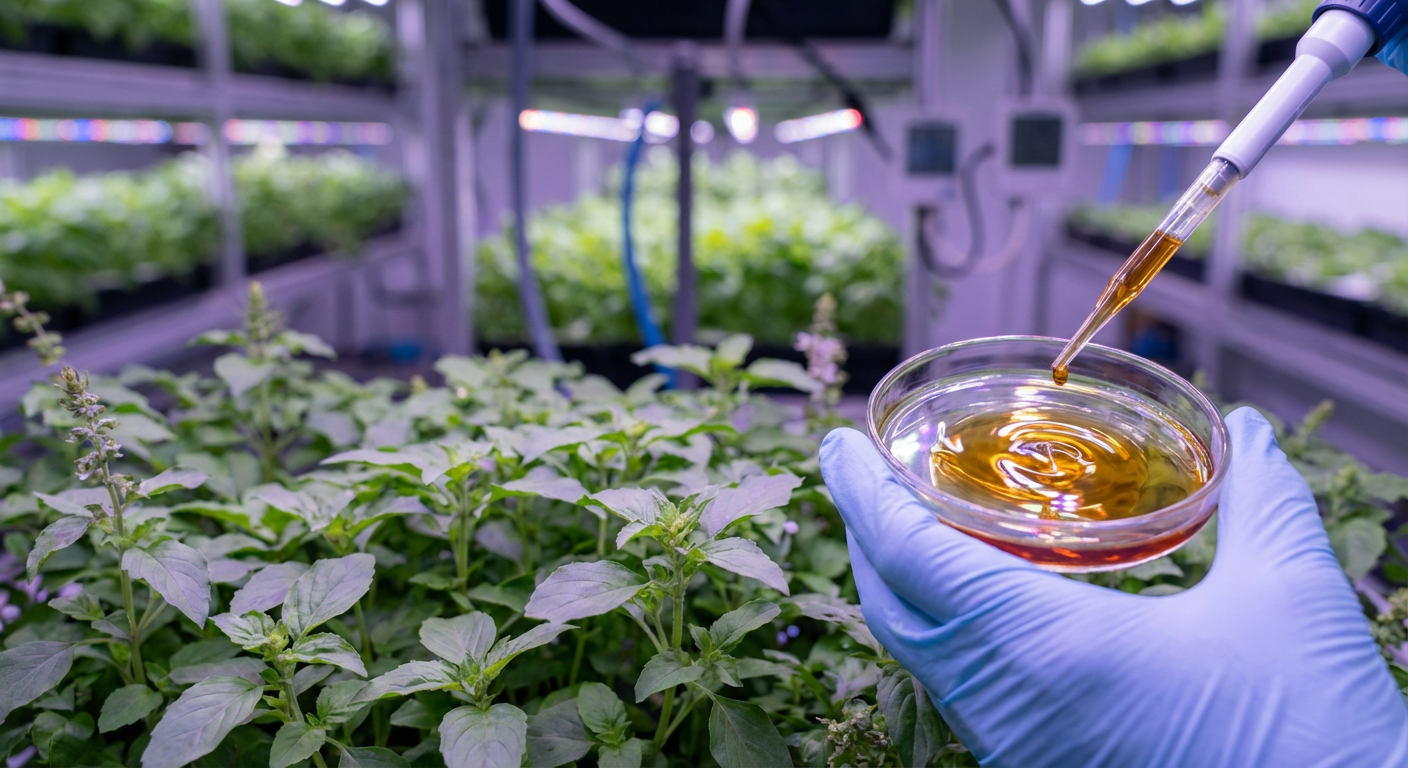
A high eugenol tulsi extract specifically refers to an extract of Ocimum sanctum (Holy Basil) standardized to contain elevated concentrations of the phenolic compound eugenol. Our internal R&D consistently achieves 9,416 mg/kg eugenol from vertically farmed Ocimum sanctum, verified by independent analysis at CTAEX lab in 2025. This concentration exceeds typical field-grown yields.
This enhanced potency is attributed to controlled abiotic stress protocols, which function as xenohormetic triggers. These stressors, including UV-B irradiation and specific elicitors, induce a targeted secondary metabolite upregulation in the plant. Consequently, the resulting extract delivers a significantly higher therapeutic index per unit mass.
Phytochemical Profile of Supernormal Greens' Ocimum sanctum
Compound | Concentration (mg/kg) | Comparison vs. Field-grown (typical) | Role |
|---|---|---|---|
Eugenol | 9,416 | 3–30x higher | Antimicrobial, anti-inflammatory |
Ursolic Acid | Noted | Consistent | Anti-inflammatory, skin barrier support |
Rosmarinic Acid | Noted | Consistent | Antioxidant, anti-inflammatory |
Carvacrol | 511 | Typically absent in field-grown | Antimicrobial, antioxidant |
Linalool | Noted | Consistent | Aromatic, anxiolytic properties |
β-Caryophyllene | Noted | Consistent | Anti-inflammatory |
Chemotype, Season and Harvest Stage: Getting Eugenol Right
Achieving maximal eugenol levels in Ocimum sanctum extracts necessitates precise control over plant genetics, growing conditions, and harvest timing. Our cultivation strategy integrates these factors to ensure consistent phytochemical profiles. Vertical farming environments mitigate the variability inherent in traditional agriculture.
Optimizing Eugenol Biosynthesis
Genotype Selection: Specific chemotypes of Ocimum sanctum are chosen for their genetic predisposition to high eugenol synthesis.
Abiotic Stress Protocols: Controlled UV-B exposure, drought, and MeJA applications during specific growth phases stimulate the plant's defense mechanisms.
Nutrient Management: Optimized nutrient delivery systems provide precursors essential for phenylpropanoid pathway activation and eugenol production.
Growth Cycle Timing: Harvest occurs at the developmental stage where eugenol accumulation reaches its zenith, typically identified through real-time phytochemical monitoring.
These controlled environmental parameters ensure batch-to-batch consistency not achievable in open-field cultivation. This removes the reliance on seasonal variations or external climate factors that frequently impact raw material quality and secondary metabolite concentration.
Extraction Engineering: SC–CO2 vs. Steam Distillation for Eugenol Yield
The choice of extraction method profoundly influences the final phytochemical composition and purity of an extract. Supercritical CO₂ (SC-CO₂) extraction offers distinct advantages over traditional steam distillation for salvaging high eugenol content from Ocimum sanctum. SC-CO₂ extraction consistently delivers higher purity and avoids thermal degradation of sensitive compounds.
Comparative Extraction Efficiencies for Eugenol
Feature | SC-CO₂ Extraction | Steam Distillation |
|---|---|---|
Selectivity | High: targets specific non-polar compounds (eugenol) | Moderate: less selective, co-extracts water-soluble compounds |
Solvent Purity | CO₂ leaves zero residual solvent | Water can leave trace impurities; requires complex separation |
Thermal Degradation | Minimal: low operating temperatures (e.g., 50°C) | Significant: high temperatures (100°C+) can degrade thermosensitive compounds |
Yield (Eugenol per dry leaf) | Up to 2.96 mg/g (optimized conditions) | Variable, often lower purity; ~13.91 mg per 5g extract from field-grown |
Scalability | Industrial scale, reproducible and controllable | Industrial scale, but less precise control over volatile profiles |
Purity of Extract | High, often requires less post-processing | Requires further purification steps to achieve comparable purity |
An optimization study on SC-CO₂ extraction demonstrated yields of up to 2.96 mg eugenol per gram of dry leaves under specific conditions (50°C, 200 bar, 90 min). This highlights the method's capacity for targeted isolation. Our proprietary stress protocols, combined with optimized SC-CO₂ extraction, contribute to the 9,416 mg/kg eugenol verified in our extracts.
Biological Rationale: Anti-inflammatory and Antimicrobial Actions of Eugenol
Eugenol is a primary bioactive in Holy Basil (Ocimum sanctum) phytochemical profiles, recognized for its anti-inflammatory and antimicrobial properties. These actions are mediated through various biological pathways, making high eugenol tulsi extract relevant for cosmetic, nutraceutical, and pharmaceutical applications.
Multifaceted Actions of Eugenol
Antimicrobial Activity: Eugenol disrupts microbial cell membranes, inhibiting bacterial and fungal growth. Its minimum inhibitory concentrations (MICs) against Neisseria gonorrhoeae range from 85–256 mg/L in preclinical assays.
Antifungal and Antiaflatoxigenic: Tulsi essential oil and eugenol inhibit the growth of Aspergillus flavus and its aflatoxin production at concentrations as low as 0.3–0.1 µl/ml.
Anti-inflammatory Effects: Eugenol modulates inflammatory pathways by inhibiting pro-inflammatory mediators and scavenging free radicals, as supported by in vitro phytochemical profiling.
Antioxidant Properties: The phenolic structure of eugenol contributes to its robust antioxidant capacity, protecting against oxidative stress.
For formulators considering natural alternatives, the antimicrobial efficacy of eugenol allows its use as an eugenol natural preservative in cosmetics, reducing reliance on synthetic agents. Furthermore, the presence of other compounds like ursolic acid synergistically contributes to these biological actions.
Human Evidence with Tulsi Extracts: Stress, Cognition and Metabolism
While eugenol possesses established biological activity, human evidence regarding whole tulsi extracts extends beyond single-compound effects. Research indicates that Ocimum sanctum extracts can influence stress responses, cognitive function, and metabolic parameters.
Clinical and Traditional Uses
Adaptogenic Properties: Holy Basil is traditionally used as an adaptogen, supporting the body's ability to cope with physical and psychological stress.
Cognitive Support: Initial human studies suggest potential benefits for attention, memory, and mood, although larger trials are needed to confirm these effects.
Metabolic Health: Some evidence points towards a role in supporting healthy blood glucose and lipid metabolism, which contributes to its traditional use in various health systems.
Immunomodulation: The array of bioactives in tulsi, including eugenol and rosmarinic acid, contributes to its immunomodulatory potential, supporting overall immune function.
These broader systemic effects represent a key differentiator for whole tulsi extracts compared to isolated eugenol. Further research on rosmarinic acid vs ursolic acid within the Holy Basil matrix continues to elucidate the plant’s full potential.
Safety & Compliance: JECFA ADI, IFRA Limits and EU Allergen Labelling
The integration of high eugenol tulsi extracts into commercial products requires strict adherence to regulatory guidelines. Key considerations include acceptable daily intake (ADI) levels set by bodies like JECFA, IFRA standards for fragrance applications, and EU allergen labeling requirements.
Regulatory Framework for Eugenol
JECFA ADI: The Joint FAO/WHO Expert Committee on Food Additives (JECFA) establishes ADI for food additives and contaminants, including eugenol. This guides safe consumption levels in nutraceuticals.
IFRA Standards: The International Fragrance Association (IFRA) sets limits for eugenol in fragrance compounds due to its potential for skin sensitization. These limits vary by product category and exposure level.
EU Allergen Labelling: Eugenol is recognized as a contact allergen in the EU. Products containing eugenol beyond specified thresholds must declare it on the ingredient list under the Cosmetics Regulation (EC) No 1223/2009.
Genotoxicity Concerns: While preliminary, some studies prompted evaluation of related compounds like methyleugenol and estragole in basil tinctures. The EFSA safety opinion on basil tinctures, while not for Ocimum sanctum, highlights the need for rigorous safety assessment of all active compounds.
Our pharma-grade microbial cleanliness and full European traceability provide a robust foundation for regulatory compliance. This allows B2B buyers to confidently formulate within established safety parameters, ensuring product integrity and consumer safety.
Formulation Playbook: Oral and Topical Design Within Exposure Limits
Formulating with high eugenol tulsi extract demands a clear understanding of its properties and regulatory restrictions for both oral and topical applications. Strategic design ensures efficacy while adhering to safety thresholds.
Key Considerations for Formulators
Controlled Release Systems: Encapsulation or micro-emulsification can modulate eugenol release, minimizing irritation in topical applications.
Synergistic Blends: Combining eugenol with other bioactives, such as what is eugenol as a component of other botanical extracts, may allow lower overall eugenol concentrations while maintaining efficacy.
Patch Testing: For topical products, rigorous patch testing is critical to assess skin sensitization potential, especially in sensitive populations.
Dosage Titration: Starting with minimal effective concentrations and gradually increasing to assess tolerance is a standard practice in oral formulations.
Understanding these parameters enables the development of stable, safe, and effective products. Our high-potency extract means smaller inclusion rates can achieve desired functional benefits, optimizing formulation costs.
Market Outlook and B2B Differentiators for High-Eugenol Tulsi
The market for high-value botanical ingredients is driven by consumer demand for natural products, regulatory shifts, and supply chain vulnerabilities. High eugenol tulsi extract from vertical farms offers compelling B2B differentiators in this evolving landscape.
Strategic Advantages for Buyers
Reliable Supply: Vertical farming offers consistent, year-round production, mitigating seasonality and geopolitical risks affecting traditional supply chains. This is critical as EUDR threatens 35–55% of tropical supply by 2027.
Enhanced Potency: Eugenol content of 9,416 mg/kg provides a performance advantage, enabling lower inclusion rates and cost-effective formulations.
Sustainability Credentials: Our LCA data shows 0.72 kg CO₂-eq/kg, significantly lower than the vertical farm average (1.9 kg) and imported botanicals (1.4 kg), aligning with corporate sustainability goals.
Pharma-Grade Cleanliness: Zero pesticides, full European traceability, and stringent microbial controls meet the highest quality standards for pharmaceutical, nutraceutical, and cosmetic applications.
The hair loss market, exceeding €12B, currently contends with inconsistent supply of traditional botanicals like bhringraj. High eugenol tulsi could provide a stable, potent alternative within this rapidly growing sector. Tulsi is also trending as the #1 adaptogen in 2025, further boosting its market relevance.
Frequently Asked Questions
What eugenol levels can be reliably achieved in Tulsi extract?
Our proprietary vertical farming methods, combined with abiotic stress protocols, reliably achieve eugenol concentrations of 9,416 mg/kg in Ocimum sanctum extracts, verified by independent CTAEX lab analysis in 2025. This represents a 3-30x increase compared to typical field-grown botanicals.
How does SC‑CO₂ extraction compare to traditional methods for potency and purity?
SC-CO₂ extraction provides superior selectivity and purity compared to traditional steam distillation, particularly for non-polar compounds like eugenol. It operates at lower temperatures, minimizing thermal degradation, and leaves no residual solvent, resulting in a cleaner, more potent extract.
What are the in vitro and in vivo antimicrobial thresholds for eugenol?
Preclinical studies indicate that eugenol inhibits Neisseria gonorrhoeae with minimum inhibitory concentrations (MICs) between 85–256 mg/L in vitro. For antifungal activity, eugenol concentrations of 0.1–0.3 µl/ml inhibit Aspergillus flavus growth and aflatoxin production.
What safety data exist regarding eugenol toxicity and sensitization?
Eugenol's safety profile includes an oral LD₅₀ of approximately 2 g/kg in rats, with essential oils showing an LD₅₀ of ~4571 µl/kg in mice. However, eugenol is a known potential irritant and sensitizer, requiring careful formulation within regulatory limits such as IFRA standards and EU allergen labeling.
Can vertical farming deliver consistent phytochemical profiles for Tulsi?
Yes, vertical farming provides precise control over environmental parameters and abiotic stress application, enabling consistent and optimized phytochemical profiles in Ocimum sanctum. This significantly reduces batch-to-batch variability compared to open-field cultivation.
How does regulatory approval for Ocimum sanctum extracts compare to basil?
There is no direct regulatory dossier for Ocimum sanctum extracts. However, related species like Ocimum basilicum have received EFSA safety opinions for tinctures with very low levels of certain compounds, indicating that safety data for Ocimum sanctum would need thorough product-specific evaluations for market approval in functional ingredients.
What COA standards are required by cosmetic, nutraceutical, and pharma buyers?
Cosmetic, nutraceutical, and pharma buyers typically require Certificates of Analysis (COA) detailing active compound concentration (e.g., eugenol), microbial limits (e.g., total plate count, yeast and mold), heavy metal content, pesticide residues (zero tolerance for vertical farming), and solvent residues. European traceability and pharma-grade cleanliness are also critical requirements.
Are there patents covering high‑eugenol Tulsi extraction or formulation?
While specific patents for high-eugenol tulsi extraction or formulation are not widely documented in publicly searchable databases, this area likely represents a competitive advantage for companies employing proprietary abiotic stress cultivation methods and optimized extraction techniques.
What are sustainability benefits of vertical farm cultivation of Tulsi?
Vertical farming of tulsi offers significant sustainability benefits, including a dramatically lower carbon footprint (0.72 kg CO₂-eq/kg compared to 1.9 kg for average vertical farms and 1.4 kg for imported botanicals), minimal water usage, zero pesticide application, and land-use efficiency. It also ensures 100% EUDR compliance by design.
How do eugenol yields vary between plant varieties and extraction parameters?
Eugenol yields vary significantly between Ocimum sanctum chemotypes and are highly dependent on extraction parameters. For instance, SC-CO₂ extraction optimizes yield based on temperature, pressure, and time. Our internal R&D demonstrates that specific abiotic stress protocols can profoundly enhance natural yields across chosen varieties. The consistent potency and purity of vertically farmed Ocimum sanctum offer a strategic advantage for ingredient buyers navigating increasingly complex supply chains. This approach addresses both efficacy demands and stringent regulatory requirements across cosmetic, nutraceutical, and pharmaceutical sectors. Contact Supernormal Greens to request samples and specifications.
.jpg)