


Can Plants Be Standardised?
Quick answer
Why Controlled Environment Agriculture Is Changing Botanical Ingredients
Plants are remarkable biochemical systems. Over millions of years they have evolved to produce complex molecules that interact with biological pathways in animals and humans. Many of today’s most important cosmetic actives, nutraceutical compounds, and pharmaceutical drugs originate from plant metabolism.
But plants also come with a fundamental challenge: variability.
For companies developing botanical ingredients, achieving consistent plant chemistry can be surprisingly difficult. Two plants of the same species may look identical, yet their phytochemical composition can differ significantly depending on where and how they were grown. This variability has shaped botanical supply chains for centuries, and it remains one of the biggest barriers to reliable plant-based ingredients today.
So the question becomes increasingly relevant for modern ingredient development:
Can plants actually be standardised?
Controlled Environment Agriculture (CEA) is beginning to provide a meaningful answer.
The Natural Variability of Plants
Most botanical ingredients today originate from open-field agriculture. Plants are cultivated across different regions of the world, exposed to changing climates, soil types, and seasonal conditions before entering global supply chains.
This approach allows plants to be grown at scale, but it also introduces enormous environmental variability. Each of these variables influences plant metabolism and ultimately affects the chemical composition of the harvested biomass.
Key environmental factors include soil composition, microbial ecosystems, rainfall patterns, temperature fluctuations, sunlight intensity, photoperiod, altitude, and geographic location. Plants also respond to stress signals such as pest pressure, drought, or nutrient limitations.
Because plants constantly adapt to their surroundings, their metabolic pathways shift in response to these environmental cues. As a result, the concentration of secondary metabolites—polyphenols, terpenes, flavonoids, alkaloids, and other bioactive molecules—can vary significantly between harvests.
For food production, this variability is often acceptable. A tomato grown in Spain and one grown in Italy may differ chemically, yet both function perfectly well in the kitchen.
For botanical ingredient development, however, variability creates significant challenges.
Industries such as cosmetics, nutraceuticals, and pharmaceuticals depend on predictable chemical profiles. When plant extracts are incorporated into formulations, the concentration of key compounds must remain stable from batch to batch. If the underlying plant chemistry fluctuates too widely, achieving this consistency becomes increasingly complex.
Why Standardisation Is Difficult in Botanical Supply Chains
To manage variability, most botanical supply chains rely on post-harvest standardisation. Extract manufacturers typically analyze incoming plant material and then adjust extraction parameters to reach a desired concentration of active compounds.
In practice, this often involves blending multiple harvest batches together, concentrating or diluting extracts, and carefully controlling extraction conditions.
While this approach can work, it introduces several inefficiencies. Extraction yields become less predictable, quality control requirements increase, and larger volumes of plant material may be needed to achieve consistent results. Even with careful processing, product performance can still fluctuate depending on the chemistry of the starting material.
For industries increasingly focused on scientific validation and reproducibility, these limitations represent a growing bottleneck.
A more elegant solution would be to address variability at its source: the plant itself.
A Different Paradigm: Controlled Environment Agriculture
Controlled Environment Agriculture fundamentally changes how plants are cultivated. Instead of relying on natural environmental conditions, plants are grown inside controlled systems where key growth parameters can be regulated with high precision.
In modern CEA systems, environmental variables such as light intensity, spectral composition, photoperiod, temperature, humidity, nutrient availability, irrigation strategies, airflow, and carbon dioxide levels can all be carefully controlled.
By stabilising these parameters, plants grow under far more consistent conditions than in open-field agriculture. This creates an environment where plant development becomes significantly more predictable.
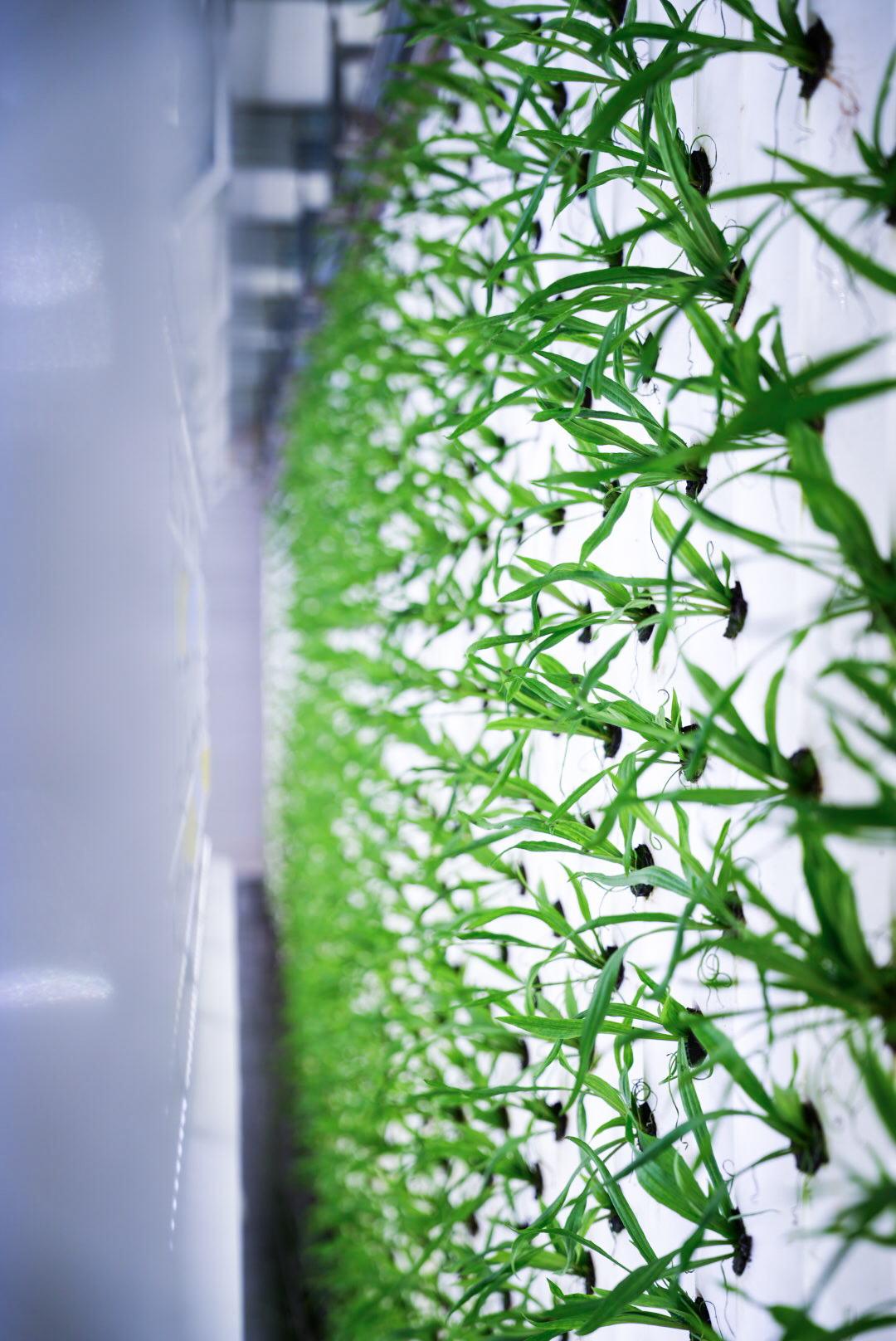
Vertical farming systems in particular allow plants to experience nearly identical environmental conditions from batch to batch. When environmental signals remain stable, plant metabolism also tends to stabilise.
Biology will never be completely deterministic. Plants remain living organisms that respond dynamically to their environment. However, the reduction in variability achievable in controlled systems can be substantial.
This shift has profound implications for the development of botanical ingredients.
From Agriculture to Biological Production Systems
When cultivation environments become controllable, plants begin to behave less like agricultural commodities and more like biological production systems.
This is especially relevant for plants grown as sources of functional compounds. Many valuable plant metabolites are strongly influenced by environmental signals. Light spectra, nutrient availability, photoperiod, and controlled stress factors all influence how plants allocate metabolic resources.
Compounds such as rosmarinic acid, eugenol, artemisinin, and cynaropicrin are examples of molecules whose expression can shift depending on cultivation conditions.
Within a controlled environment, these signals can be adjusted intentionally. Researchers and growers can experiment with cultivation strategies to understand how specific environmental parameters influence phytochemical expression. Over time, these insights make it possible to design cultivation protocols that guide plant metabolism toward more consistent chemical outcomes.
In this sense, plants are not only grown—they are guided through their environment.
Why Consistency Matters for Extract Development
For companies working with botanical extracts, consistency has enormous practical value. More uniform plant chemistry simplifies several stages of ingredient development, starting with extraction. When the chemical composition of the raw plant material is predictable, extraction processes become easier to optimise and yields become more stable.
Standardisation also becomes far more straightforward when phytochemical profiles remain relatively stable across harvests. Instead of constantly adjusting processes to compensate for fluctuating plant chemistry, manufacturers can operate with tighter specifications and greater efficiency.
This consistency benefits formulators as well. Cosmetic, nutraceutical, and pharmaceutical developers depend on ingredients that behave predictably inside formulations, both in terms of performance and stability. When plant extracts vary widely in composition, formulation becomes significantly more complex.
Researchers experience similar advantages. Scientific studies require reproducible materials, and stable phytochemical profiles make experimental results easier to validate and replicate.
In short, consistent plant material strengthens the entire value chain—from cultivation and extraction to formulation and research. It also moves botanical ingredients closer to the reliability typically associated with pharmaceutical-grade raw materials.
The Role of Supernormal Greens
At Supernormal Greens, we view Controlled Environment Agriculture as a powerful platform for advancing botanical ingredient development.
Our facility was originally designed to produce large volumes of lettuce inside a fully controlled ecosystem. Over years of cultivation we developed extensive experience managing plant environments at scale. By adjusting light spectra, nutrient composition, airflow, irrigation, and climate conditions, we learned how to create stable biological systems that could deliver highly uniform crops.
That experience ultimately revealed something important: the real value was not the lettuce itself, but the ability to control plant environments with precision.
Today that same technological foundation is being applied to medicinal and functional plants. Instead of optimising flavour, texture, or shelf life, we focus on phytochemical potential.
Plants are cultivated under stabilised environmental conditions designed to support uniform growth and predictable development. While biological variation always exists, the level of consistency achievable within a controlled system is dramatically higher than in conventional agriculture.
For companies developing botanical extracts, this consistency becomes extremely valuable. More uniform plants tend to produce more predictable chemical profiles, which simplifies extraction, formulation, and downstream standardisation.
Toward Pharmaceutical-Grade Plants
Controlled Environment Agriculture does not remove the complexity of plant biology. Plants remain living organisms shaped by genetics, physiology, and environmental signals.
What CEA does provide is a way to dramatically narrow the variability that traditionally defines botanical supply chains. Instead of relying on agricultural variability and correcting it after harvest, cultivation itself can be designed to deliver more consistent plant chemistry from the beginning.
In that sense, CEA moves botanical production closer to the idea of pharmaceutical-grade reproducibility.
The Future of Botanical Ingredients
Demand for plant-based ingredients continues to grow across cosmetics, nutraceuticals, and pharmaceutical innovation. At the same time, expectations around quality, reproducibility, and scientific validation are increasing.
Controlled Environment Agriculture offers a pathway to meet these expectations.
By combining plant biology with precise environmental control, botanical cultivation can evolve from traditional agriculture into a far more controlled and data-driven discipline.
Plants will always retain a degree of biological complexity. That complexity is part of what makes them such powerful sources of functional molecules. But with the right cultivation systems, we can move much closer to a world where botanical ingredients are not only natural, but also consistent, reliable, and scientifically robust.
Perhaps plants cannot be perfectly standardised. But they can be guided much closer to it than ever before.